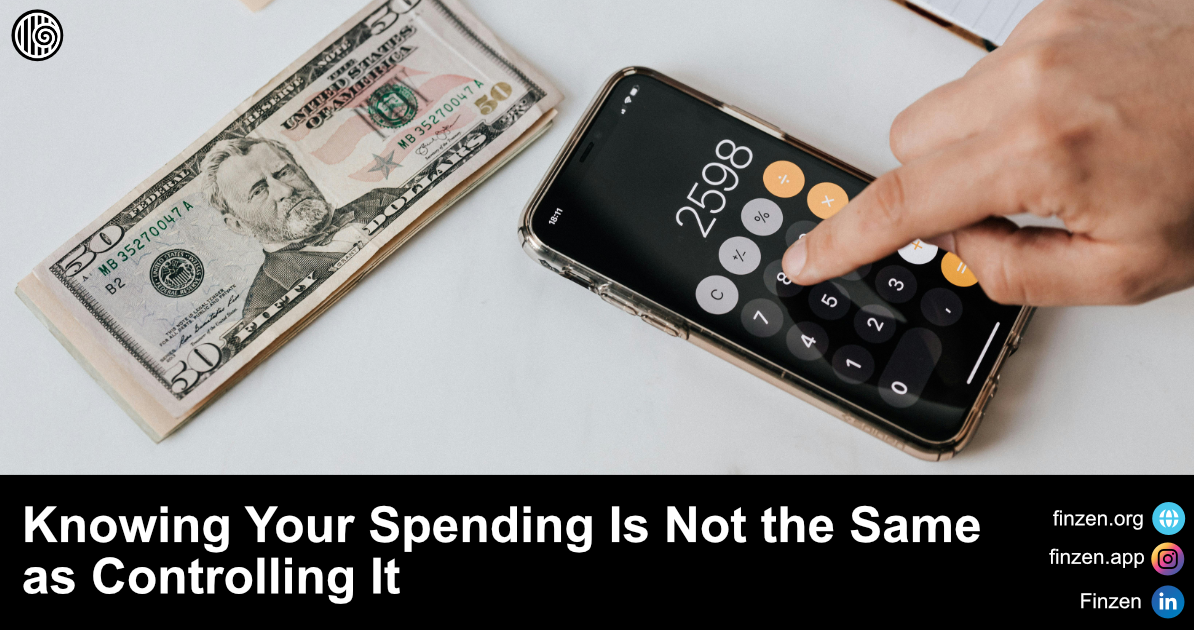
Knowing Your Spending Is Not the Same as Controlling It
There’s a gap between data and behavior. It’s wider than you think.
We live in the age of financial dashboards. Our phones show us spending breakdowns, pie charts, and category summaries — all updated in real time, automatically, without us lifting a finger.
And yet, most people still feel out of control with money.
Not because they lack information. Because knowing is not doing.
The Illusion of Awareness
There’s a concept in psychology called the intention-action gap — the distance between what we plan to do and what we actually do. It’s why people who say they want to exercise don’t go to the gym. Why people who swear they’ll spend less keep overspending.
Awareness is a prerequisite for change. But it’s not sufficient for it.
When you see a pie chart showing that you spent 38% of your income on food last month, you might feel a flash of concern. Maybe a moment of mild resolve. But that feeling fades within minutes. The pie chart doesn’t ask you to do anything. It just observes.
And observation, without intention, changes nothing.
The Myth of the Dashboard
The promise of modern budgeting apps is seductive: connect your bank, let the algorithm categorize everything, and you’ll have full visibility into your finances.
But visibility isn’t mastery.
Research in behavioral economics repeatedly shows that reducing friction — making things automatic, passive, and effortless — also reduces engagement. When you’re not actively participating in tracking your spending, you stop thinking about spending at all. The app does the thinking for you. Which sounds helpful, until you realize that the thinking is the point.
Decision fatigue is real. But so is decision atrophy — what happens when you outsource all your financial thinking to a machine and stop building the muscle of financial judgment.
What Control Actually Looks Like
Financial control isn’t a feature of any app. It’s a habit of mind.
It starts with a moment of friction, however small. The act of writing something down. Of choosing a category. Of asking yourself Was this worth it? before logging the number.
These micro-moments of reflection are where behavior change happens. Not in dashboards. Not in automated syncs. In the pause between spending and recording.
That pause creates a loop: awareness → judgment → intention. And intention, repeated enough, becomes habit.
The people who are genuinely in control of their money aren’t the ones with the most sophisticated financial software. They’re the ones who actively and deliberately pay attention to what they do with it.
The Finzen Approach
This is why Finzen is built around manual entry.
Not because automation is bad. But because passive awareness is not the same as active control. When you type in a number yourself, decide how to label it, and choose to record it, you’re not just logging data. You’re building a relationship with your money.
Every entry is a small decision. Every decision is a small act of control.
That’s not friction to be removed. That’s the whole point.
Financial zen isn’t about knowing where your money went. It’s about knowing where it’s going — and meaning it.
Try Finzen at finzen.org.