Finzen
Live Multi-Asset Portfolio Tracking
Track stocks, crypto, ETFs, commodities, forex, and more in one beautiful dashboard. Always see your net worth and portfolio in real time

-Logo.wine.png)



.png)



.png)


DIY-Investing done right
With great power comes great responsibility
Modern investors have unprecedented access: stocks, ETFs, crypto, commodities, forex, futures, and more. You can build a multi-asset portfolio that would have been impossible a decade ago. But with wealth scattered across multiple platforms, how do you actually know if you're winning? Your crypto might be up 40%, but if you don't account for your underperforming ETFs, shrinking cash reserves, and that commodity position you forgot about, you have no idea what your real returns are.
Stop Guessing. Start Knowing.
-
All Major Asset Classes
Track stocks, crypto, ETFs, commodities, forex, and futures in one unified dashboard; no more juggling apps.
-
Visual Insights
Transform complex portfolio data into beautiful diagrams, performance charts, and interactive analytics.
-
True Net Worth
See your complete financial picture with real-time tracking of assets, investments, debts, and monthly growth.
-
Institutional-Grade Analytics
Get risk-adjusted returns, annualized volatility, and ROI calculations. Professional metrics for every investor.
-
Smart Projections
Forecast your financial future with data-driven predictions based on your actual performance and cash flow trends.
-
Budget Connected
The only portfolio tracker that integrates with zero-based budgeting for complete financial clarity.
True Diversification Is Multi-Asset
Portfolio diversification isn't about owning 50 different stocks. It's about owning asset classes that don't move together. When markets fall, commodities often rise. When crypto crashes, bonds stay stable. When currencies shift, your forex positions adapt. That's how you protect wealth and capture opportunities across every market condition.
The problem? No platform lets you trade everything. Your stocks are with one broker, crypto on an exchange, commodities and forex scattered elsewhere. Provider fragmentation is inevitable.
Finzen eliminates tracking fragmentation.
Asset classes
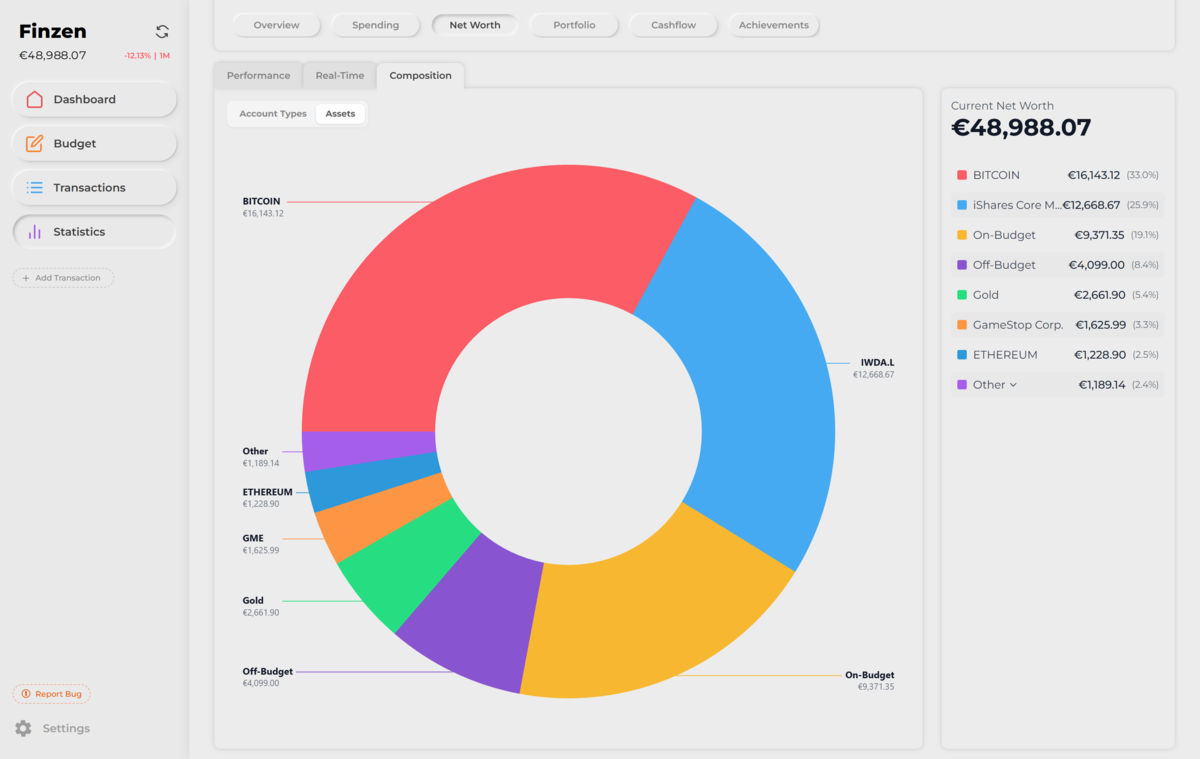
A modern portfolio is more than just stocks. Track crypto, commodities, forex, and every asset class you invest in - all in one dashboard. No more app juggling. No more blind spots.
Every asset class. Every account. One complete view. That's how you track real portfolio performance - not just individual positions in isolation.
Learn how investment accounts work in FinzenYour investment portfolio at a glance
Every data point you need to invest with confidence, in real-time.
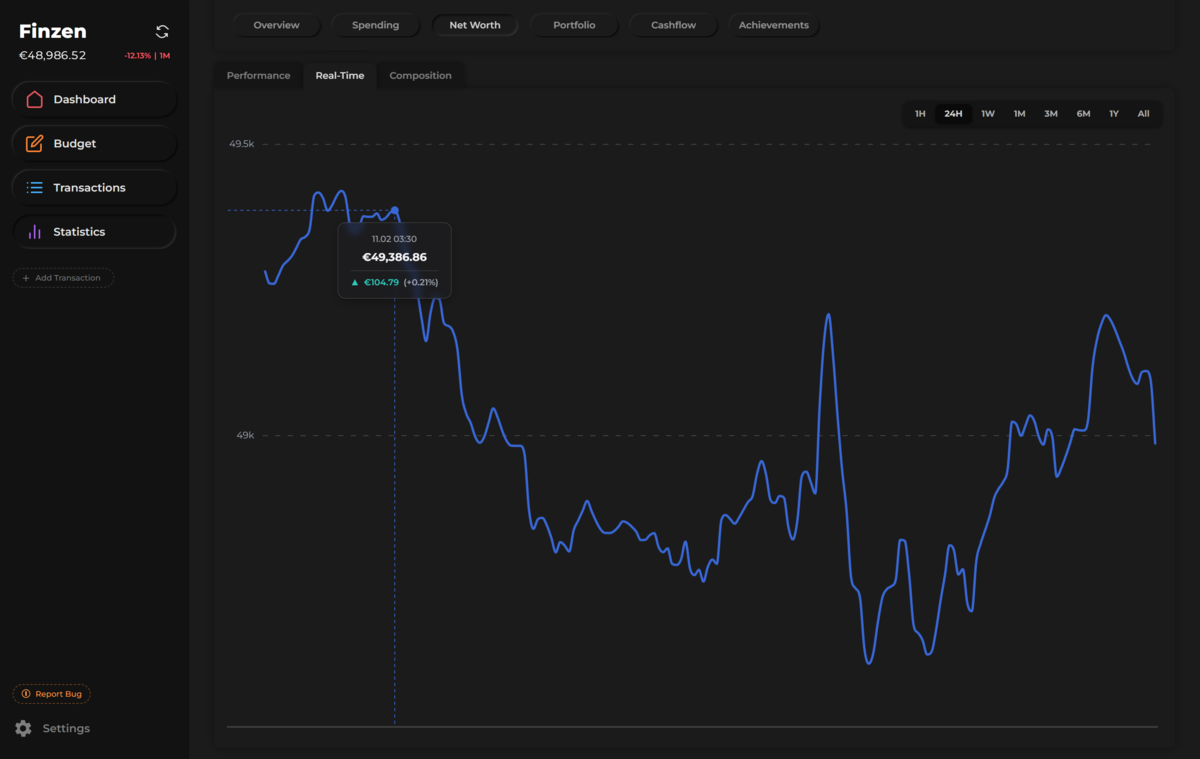
Portfolio Insights
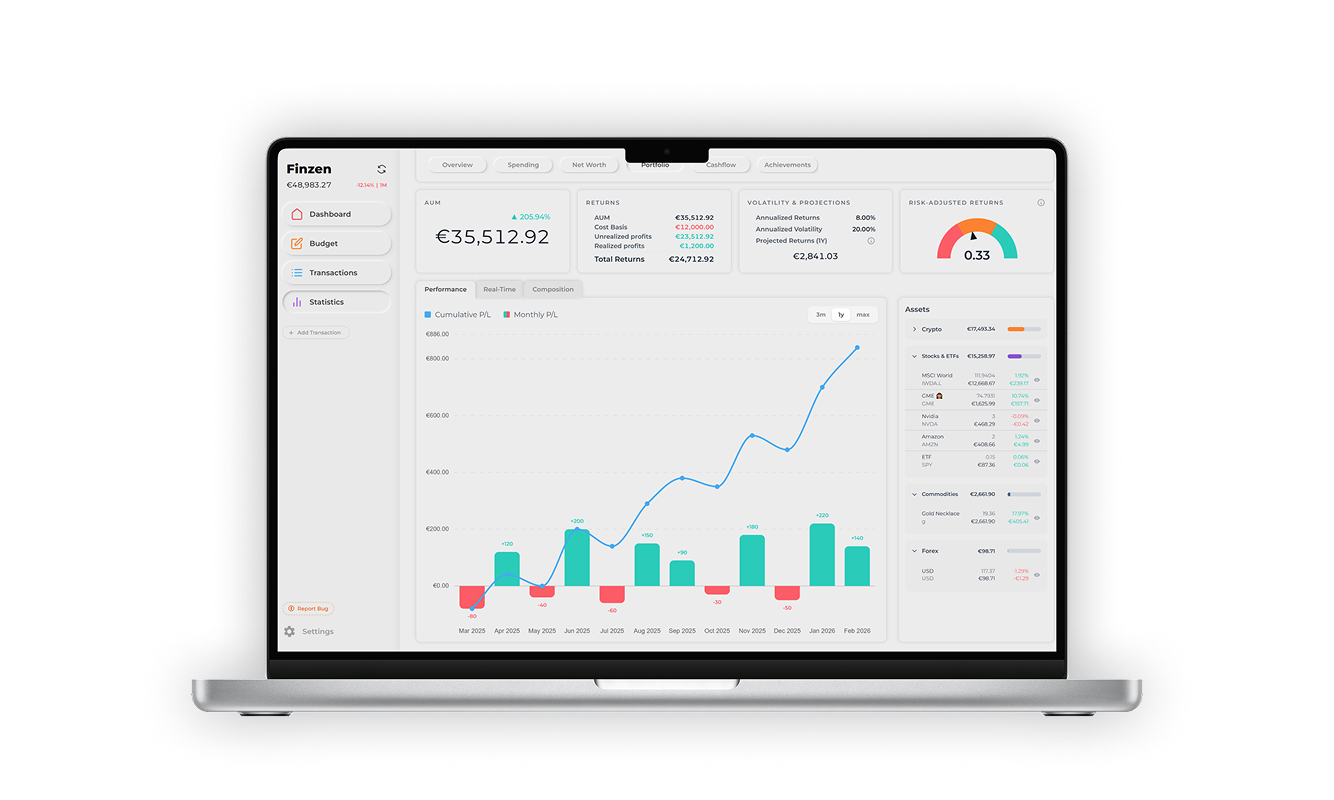
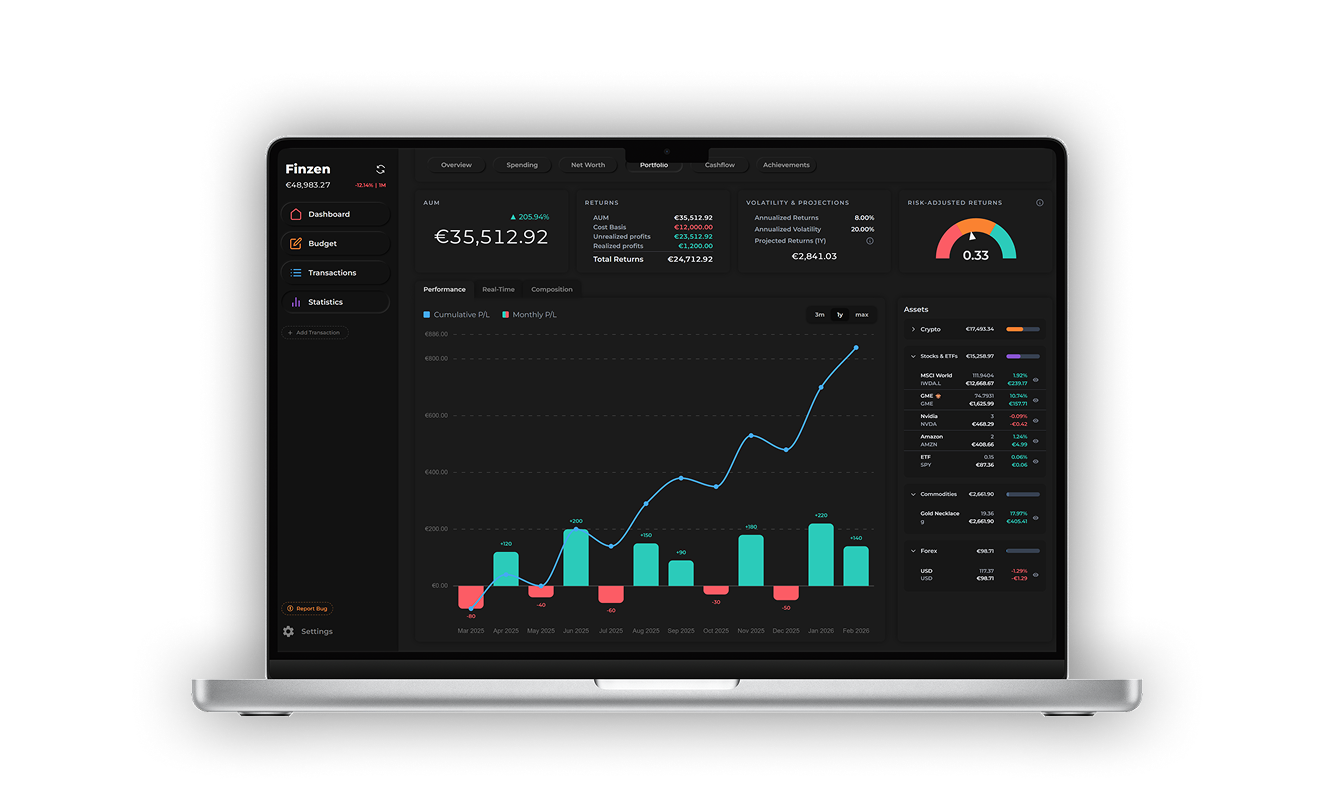
Your wealth story told in data. Monthly net worth snapshots, cumulative P/L trends, and long-term performance charts show you exactly how your investments are growing over time - not just today's balance.
Real-Time Performance
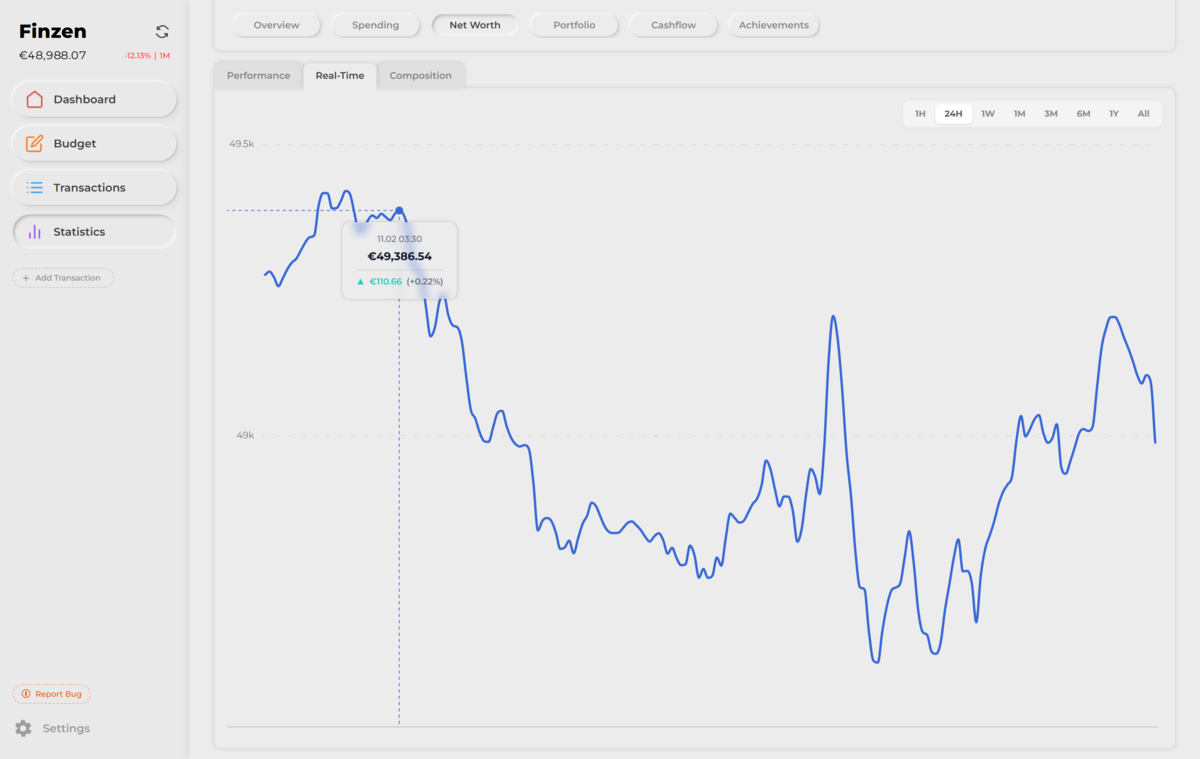
Don't wait for end-of-day reports. Your dashboard updates live as markets move, so you always know your current positions, today's gains or losses, and your exact net worth right now.
Allocation & Assets
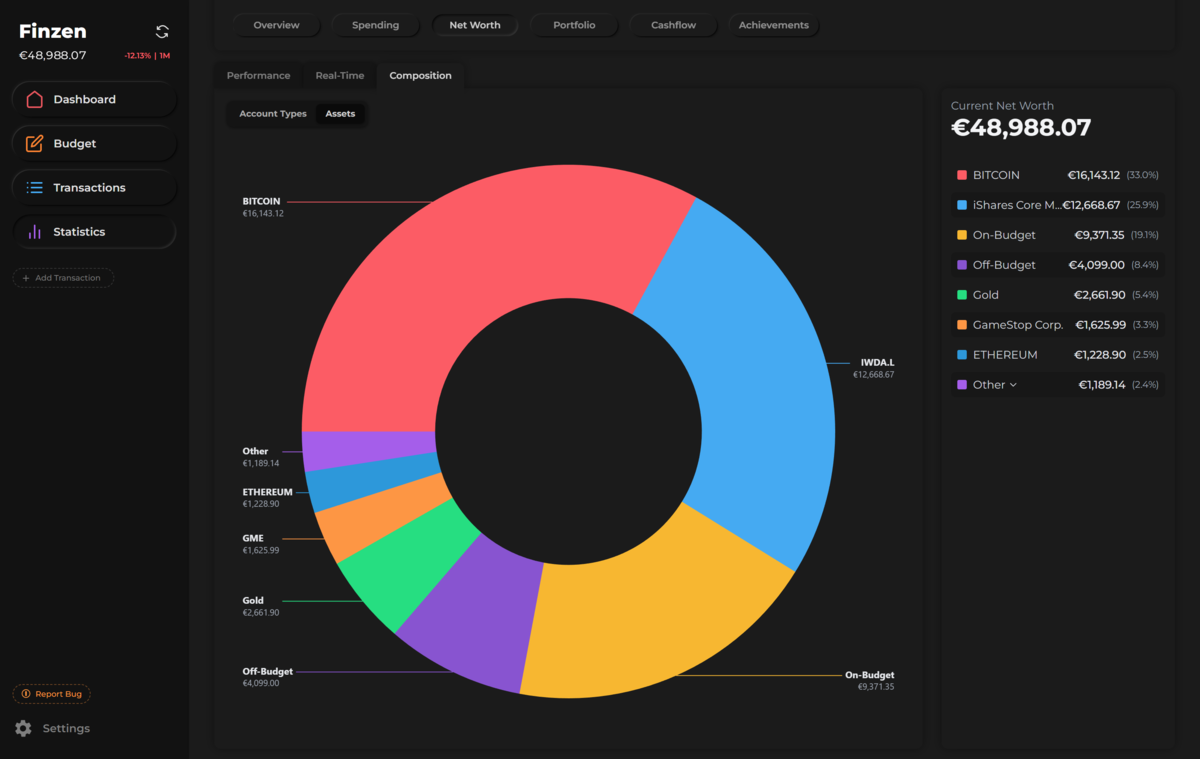
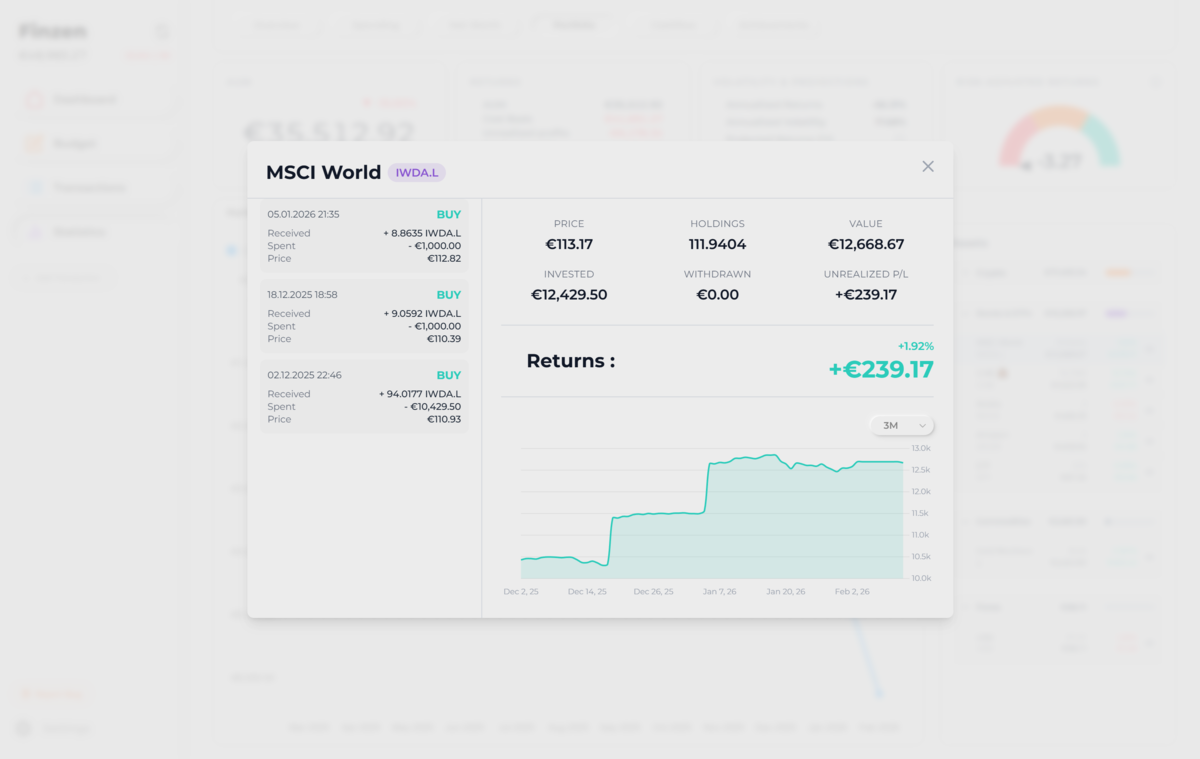
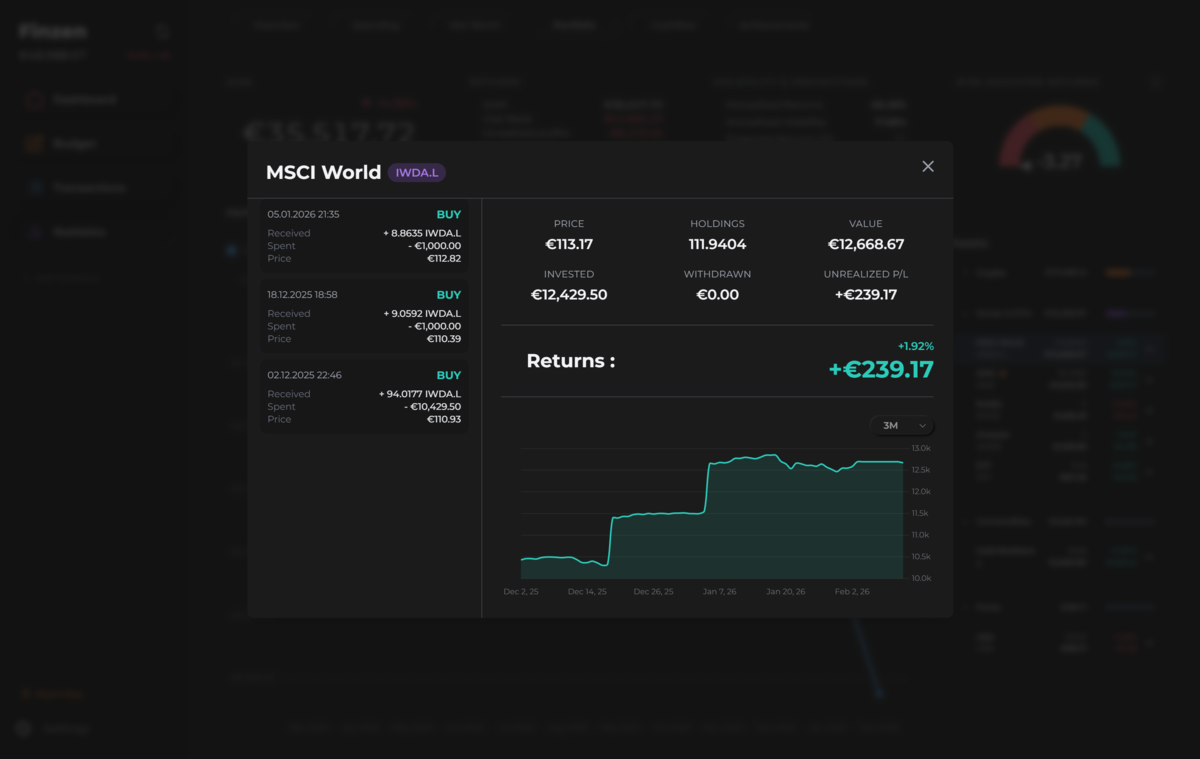
See how your portfolio is distributed across stocks, crypto, commodities, and more. Then zoom in to analyze individual asset performance, compare returns by class, and identify what's working (and what's not).
Complete portfolio control means seeing everything: macro trends that guide strategy, real-time data that informs decisions, and granular metrics that reveal opportunities.
That's what Finzen delivers.
See how Finzen uses data visualization to support DIY Investors: explore charts and reports →
Institutional-Grade Analytics for Every Investor
Professional metrics that actually make sense
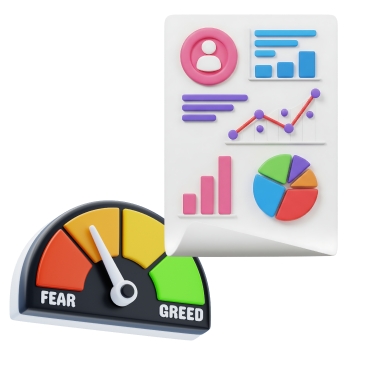
Wondering if you're really beating the market? Finzen gives you the same performance analytics used by hedge funds and wealth managers: risk-adjusted returns, annualized volatility, Sharpe ratios, and more.
- Risk-Adjusted Returns See your real performance relative to the risk you took
- Annualized Volatility Understand how stable (or wild) your investments are
- ROI Tracking Know your actual returns, not just account balances
- Realized vs Unrealized Gains Separate profits you've taken from paper gains
- Per-Asset Performance Compare how each investment is actually performing
- Smart Projections Data-driven forecasts based on your real track record
Privacy-First Investment Tracking
Your Portfolio Data Stays Yours
Most portfolio trackers need access to your accounts. One breach, total exposure. Some fintechs sell your holding data outright.
Finzen encrypts everything client-side with AES-256 before transmission. Zero-knowledge architecture means encryption keys never touch our servers. No broker sync, no exchange API, EU-based under GDPR. We physically cannot decrypt your portfolio data.
Your investments. Your data. Your control.
From Investment Growth to Budget Control
Investments
Track portfolio performance, returns, and allocation. See real-time net worth, analyze risk-adjusted metrics, and project future wealth across all asset classes.
Budget
Know your spending baseline, cashflow, and what's truly available to invest. Envelope budgeting shows your runway and prevents investing money you might need.
You can't build a solid investment strategy without knowing your spending reality. How much can you safely invest this month? That depends on your cashflow. How large should your cash reserves be before adding to risky assets? That depends on your actual monthly expenses. Investing and budgeting aren't separate problems. Track your portfolio to measure growth, but track your budget to know what you can afford to risk - and what you need to keep liquid.
Finzen keeps it connected so your investment decisions are based on reality, not guesses.
Track Everything in 3 Steps
Simple setup. Daily awareness. Long-term clarity.
Add Your Accounts
Set up your investment accounts, crypto wallets, and asset holdings once. Takes 5–10 minutes. No account connections - just input your assets.

Log Daily Activity
Spend 2–3 minutes recording your transactions. Quick manual entry keeps you connected to every decision and transaction.
Review & Optimize
Check your dashboard to see performance trends, rebalance allocations, and track progress toward your financial goals.
Trusted by Investors Worldwide

Lisa Chen
31 • Singapore
"Went from financial anxiety to actual clarity. Seeing my crypto, stocks, and emergency fund in one dashboard helped me realize I was over-invested in volatile assets. Rebalanced in a week. Sleeping better now."

Miguel A.
34 • Spain
"I was using five different apps and still had no idea if I was diversified properly. Finzen's asset allocation view showed me I had 60% in crypto and almost nothing in stable assets. Wake-up call I needed. And the privacy model is perfect for EU users."

Marcus T.
28 • Germany
"I was tracking crypto in Delta, stocks in Yahoo Finance, and my gold holdings in a spreadsheet. Finzen finally gave me one place to see my actual net worth. The portfolio dashboard is incredible."
Common questions
-
Risk-adjusted returns measure how much return you earned relative to the volatility (risk) you took to get there. A portfolio that returned 15% with low volatility is often better than one that returned 20% with massive swings, especially if those swings would have caused you to panic-sell at the bottom. The most common metric is the Sharpe ratio: (return minus risk-free rate) divided by volatility. A higher Sharpe means you're earning more return per unit of risk. Two portfolios with identical returns can have very different risk profiles. One might be a steady climb, the other a white-knuckle rollercoaster. Risk-adjusted metrics reveal which strategy is actually superior.
-
There's no one-size-fits-all answer. It depends on your age, risk tolerance, time horizon, and financial goals. Traditional advice suggests stocks/bonds ratios based on age (e.g., "110 minus your age" in stocks), but modern portfolios often include crypto (5-10% for aggressive investors), commodities (5-15% as inflation hedges), and alternative assets. The key principle: hold asset classes that don't move in perfect correlation. When stocks fall, commodities or forex might rise. Younger investors can tolerate more volatility and might go 60-70% equities, 10-15% crypto, 10-15% commodities, 5-10% cash. Older investors might prefer 40% stocks, 30% bonds, 20% commodities, 10% cash. Regular rebalancing (quarterly or semi-annually) maintains your target allocation as different assets outperform.
-
Annualized volatility measures how much your portfolio value fluctuates over time, expressed as a percentage. A portfolio with 15% annualized volatility means you can expect the value to swing up or down by roughly 15% in a typical year. Low volatility (5-10%) suggests stable, predictable returns, think bonds or dividend stocks. High volatility (30-50%+) means wild swings, common with crypto or individual growth stocks. Knowing your portfolio's volatility helps you: (1) assess if you can stomach the ups and downs psychologically, (2) compare different investment strategies on a risk-adjusted basis, and (3) size positions appropriately. A volatile asset shouldn't dominate your portfolio. Volatility isn't inherently bad, but you need to know what you're signing up for.
-
Concentration risk is when a single asset, sector, or asset class dominates your portfolio. If it crashes, you're in trouble. Classic example: Enron employees with 60% of retirement in company stock. In multi-asset portfolios, concentration often creeps in unintentionally. Maybe crypto boomed and now represents 40% of your net worth even though you only invested 10%. General guidelines: no single stock should exceed 5-10% of your portfolio, no single asset class should exceed 50-60% (except for very young, aggressive investors), and no single sector should dominate. Geographic concentration also matters. Don't put everything in your home country. The right concentration level depends on risk tolerance and time horizon, but if losing 50% of one position would derail your financial plans, you're too concentrated.
 Finzen
Start Tracking Your Portfolio
Stop guessing at your portfolio performance. Track stocks, crypto, commodities, and every asset class in one private dashboard. Get institutional-grade analytics without the institutional fees. Start tracking your complete wealth today.
Continue exploring
Budget & Track Spending
Give every dollar a purpose. Set spending envelopes by category, log purchases as you go, and see your remaining budget update in real time.
Charts, Reports & Insights
Log your spending, get the full picture. Daily entries become spending flows, budget charts, portfolio views, and a net worth timeline. All in one place.
Privacy & Security
Finzen uses AES-256 encryption, EU servers, and zero-knowledge architecture. We can't read your financial data even if we wanted to. Privacy by design.