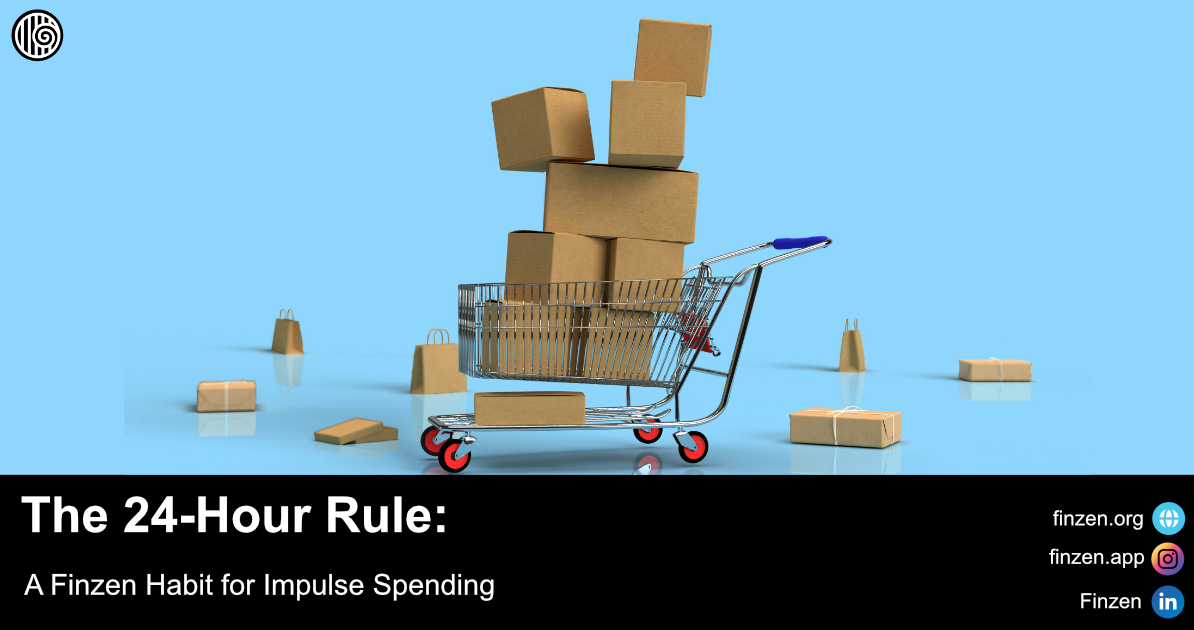
The 24-Hour Rule: A Finzen Habit for Impulse Spending
You see it. You want it. The “Buy Now” button is right there.
That split-second gap between desire and action is where most financial decisions are won or lost. And modern retail is engineered to make that gap as short as possible.
The 24-Hour Rule is simple: commit to waiting a full day before completing any non-essential purchase. No complex system, no spreadsheet. Just a pause.
Why impulse buying is so hard to resist
Impulse buying is not a discipline problem. It is a brain chemistry problem.
When you spot something you want, your brain releases dopamine before you have even decided to buy. The reward system fires on anticipation alone. Research confirms that dopamine-driven urges peak and fade within 20 to 30 minutes if not acted upon [1]. That urgency you feel is temporary by design, both neurologically and commercially.
Retailers know this. Countdown timers, “only 3 left in stock” notices, and one-click checkout are all built to compress your decision window before the urge subsides. According to a 2025 consumer research report, 44% of shoppers feel regret after an impulse purchase, and the average consumer spends around $282 per month on unplanned items [2].
What happens when you wait
Behavioral economists call the underlying mechanism delay discounting: the tendency to overvalue a reward available right now compared to one available later [3]. The longer the gap between desire and decision, the more weight your brain gives to future consequences — your budget, your goals, the clutter in your home.
Research on delayed gratification consistently shows that the ability to pause before acting is one of the strongest predictors of long-term financial stability [4]. The 24-hour rule creates that pause deliberately. According to Simply Psychology, it is considered effective for mild-to-moderate spending impulses precisely because it exploits the temporal nature of urges: the impulse is strongest in the moment, and friction at the point of purchase allows it to pass [5].
Sleep also plays a role. A waiting period that includes overnight rest restores the cognitive resources tied to executive function, helping the prefrontal cortex override the emotional signals that drove the original urge [6].
How to use it with Finzen
The 24-Hour Rule works especially well alongside Finzen’s manual entry approach. When you log an expense by hand, you process it consciously. Research comparing manual and automated expense tracking finds that manual entry produces stronger behavior change than passive bank syncing, precisely because of the friction involved [7].
The rule extends this same principle upstream, before the purchase.
When the urge hits: open Finzen instead of your payment app. Note the item in the relevant envelope and see your actual budget in real time. That context alone often changes the decision.
Set a reminder for 24 hours later. You are not suppressing the desire, you are deferring the decision. That difference matters psychologically.
When the reminder fires: ask yourself three questions. Do I still want this? Does it fit my envelope? Is there something I would rather put this money toward? If all three answers are yes, buy it with intention. If any answer is no, move on.
Most of the time, the desire has already softened.
Scaling the rule
The 24-hour wait is a baseline. For larger purchases, many financial practitioners recommend scaling the delay:
- Under EUR 50: 24 hours
- EUR 50 to EUR 200: 48 to 72 hours
- Over EUR 200: one week
- Major purchases: 30 days
The bigger picture
The goal is not to spend less on everything. It is to spend intentionally on the things that matter.
There is a real difference between a purchase you decided to make and one that made itself in a moment of emotional arousal. The first tends to produce satisfaction. The second tends to produce regret, clutter, and a quiet drain on your financial goals.
A 24-hour gap is enough to tell them apart.
Finzen is a privacy-first personal finance app built for intentional spending. Manual entry, envelope budgeting, zero-knowledge architecture. Try Finzen.
References
- Whistl. (2026, March). The Psychology of Impulse Buying: Why Your Brain Can’t Resist. https://www.whistl.app/psychology-of-impulse-buying-2026.html
- WebTribunal. (2025). 55+ Impulse Buying Statistics 2026. https://webtribunal.net/blog/impulse-buying-statistics/
- Astrado. (n.d.). Avoid impulse spending using this 24-hour rule. https://astrado.org/p/avoid-impulse-spending-using-this-24-hour-rule/
- New Trader U. (2024, August). Stop Spending So Much Money by Following the 24-Hour Rule. https://www.newtraderu.com/2024/08/05/stop-spending-so-much-money-by-following-the-24-hour-rule/
- Simply Psychology. (2025). The Psychology of Compulsive Spending. https://www.simplypsychology.com/articles/compulsive-spending-psychology
- SpendTrak. (2026, March). How to Stop Impulse Buying: A Science-Backed Guide. https://spendtrak.app/how-to-stop-impulse-buying
- Zhang, C. Y. (2023). How Does Expense-Tracking Inform Financial Behaviors? Consumer Interests Annual. https://www.consumerinterests.org/assets/docs/CIA/CIA2023/ZhangYilingCIA2023.pdf